
SYSTEM / FILTRATION
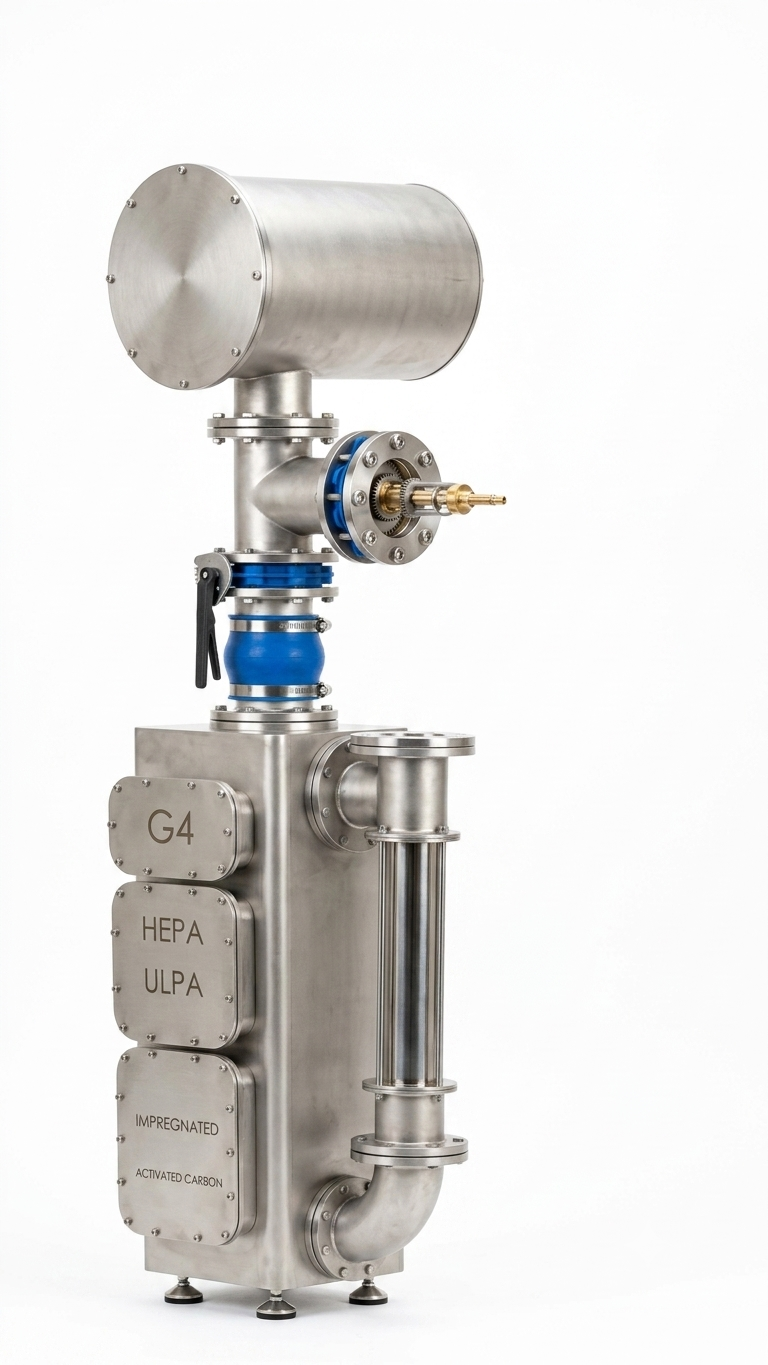
NBC / CBRN Filtration System
A shelter is measured by the air inside it, not by wall thickness. The NBC/CBRN filtration system provides multi-layer protection against biological, radioactive, chemical and indoor-air threats through a G4 pre-filter, HEPA/ULPA particulate stage, impregnated activated carbon and a CO₂ scrubber.
Coarse Filter (G4 Class) – Pre-filtration
As soon as air is drawn from the outside, it first passes through a G4-class coarse filter. This stage captures large dust, sand, pollen, soot and coarse particles, protecting the main NBC filters downstream.
- Purpose: Captures large dust, sand, pollen, soot and coarse particles from the intake air.
- Benefit: Extends the life of the main NBC filters (HEPA/ULPA and activated carbon), prevents clogging and preserves system efficiency.
HEPA and ULPA Filters – Radioactive and Biological Protection
The particulate stage is responsible for retaining radioactive fallout and biological aerosols. HEPA filters offer high particulate efficiency according to their class; ULPA targets sub-micron particles with a finer pore structure. Exact performance is verified per project against the filter class, manufacturer/model and the applicable test standard.
- Biological threats: Targets biological aerosols containing bacteria, viruses, spores and microorganisms; retention efficiency depends on the selected filter class and test conditions.
- Nuclear threats (radioactive fallout): Retains radioactive dust and particles suspended in the air. This is filtration of airborne particles — a function separate from structural radiation shielding.
- ULPA support: Its finer pore structure targets sub-micron particles, raising the protection level of the particulate stage.
Impregnated Activated Carbon Filter – Chemical Warfare Agent Protection
HEPA alone cannot stop chemical gases and vapours. At this stage, activated carbon impregnated with special chemicals comes into play, trapping harmful substances by adsorption on its surface.
- Chemical threats: Neutralises nerve agents (Sarin, VX), blister agents (mustard gas), choking agents and blood agents through adsorption.
- Toxic industrial gases: Also filters chlorine, ammonia and organic vapours that can be released during industrial accidents.
Special CO₂ (Carbon Dioxide) Collector Systems – Indoor Air Quality
In full isolation (complete sealing) mode, when outside ventilation is completely cut off, carbon dioxide rises as occupants breathe. CO₂ collector systems keep this level within safe limits.
An important distinction: CO₂ removal does not produce oxygen. CO₂ control, oxygen-level monitoring and, where required, project-appropriate oxygen supply are separate functions, each planned individually within the project scope.
- Full isolation (complete sealing) mode: Activates when the shelter's outside ventilation must be fully closed due to extreme external contamination or blast conditions.
- Purpose: Absorbs the rising CO₂ level caused by occupants breathing, keeping it within safe limits.
Positive pressure (overpressure)
Filtered air keeps the interior slightly above outside pressure, so air leaks outward through unavoidable gaps and contaminated air cannot enter. This is the principle that makes filtration meaningful.
Airtightness and shell integrity
Overpressure only holds in a sealed shell. Door seals, cable and pipe penetrations, exhaust lines and blast dampers are designed as one system and verified by pressure testing at commissioning.
Operation during power loss
The system is designed to run without grid power: a backup power path and a manual or pedal-driven emergency fan maintain airflow.
Maintenance and filter life
Filter stages have a finite life. Differential pressure gauges, recorded periodic testing and spare filter stock are what guarantee the system works when it is needed.
Frequently Asked Questions
- Does HEPA stop gases?
- No. HEPA captures particulates and aerosols; chemical gases and vapours require an activated carbon stage. Both are used together.
- How often are filters replaced?
- It depends on usage, ambient dust and exposure; periodic inspection and differential pressure readings determine the interval.
- How is the internal air renewed?
- Outside air is continuously drawn through the filter stages, while stale air is pushed out by overpressure.
- What does the CO₂ collector do?
- In full-sealing mode, when outside ventilation is cut off, it absorbs the carbon dioxide produced by occupants' breathing and keeps levels within safe limits. CO₂ removal does not produce oxygen; oxygen levels are monitored separately and, where required, oxygen supply is planned as a separate system within the project scope.
Related pages
Let's size your air system correctly
We define required airflow, filter stages and redundancy based on occupancy and duration.
Request a Technical Call